

ERCP Doctor in Chembur
If you are searching for the ERCP Doctor in Chembur, Dr. Suresh H. Pasiddhi is a Consultant Gastroenterologist with advanced training in Medical Gastroenterology and Advanced Endoscopy.
He holds an MBBS from Government Medical College, Miraj, an MD in Internal Medicine from Seth GS & KEMH, Parel, Mumbai, and a DrNB in Medical Gastroenterology from Believer's Church Medical College, Thiruvalla, Kerala. He also completed a Fellowship in Advanced Endoscopy at Antrang Hospital, Kolhapur. With over 10 years of clinical experience across roles such as Junior Resident, Senior Resident, Assistant Professor, SMO and Consultant Gastroenterologist, he is known for careful evaluation and clear, evidence-based guidance. He has presented at MAPCON and ENDO 2024 in South Korea and is a member of the Indian Society of Gastroenterology.
The Importance of Understanding ERCP and Its Various Types
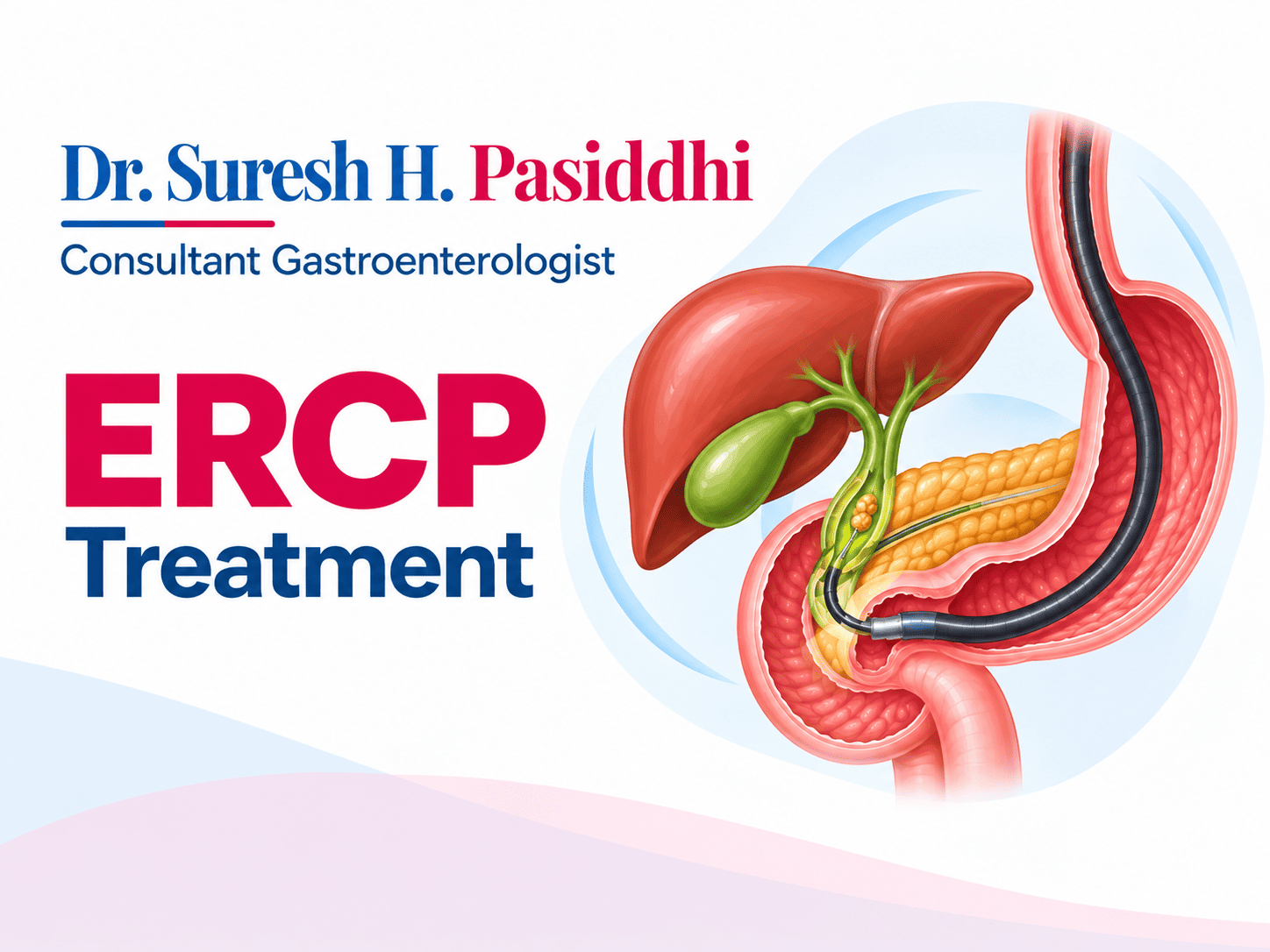
ERCP or Endoscopic Retrograde Cholangiopancreatography is a high-level procedure that is employed in diagnosing and treating conditions that afflict the bile duct, gall bladder and pancreatic ducts. During ERCP, a flexible endoscope is used in a procedure where the tube is placed from the mouth to the duodenum. X-ray technology is then used in accordance with the procedure and a thin catheter is used to access the bile and pancreatic ducts. ERCP is useful as a diagnostic tool to identify areas of obstruction or abnormalities but it is mostly employed today as a way of treating the problems. Among its methods is the removal of stones from the bile ducts, biliary and pancreatic stenting, removal/replacement of stents, widening of narrowed ducts, or draining of infected bile. Complex ERCP is considered when the anatomy is distorted, sizes of the stones or their sites are large, or previous procedures have failed.
Reasons for the Use of ERCP
ERCP is usually performed for several problems affecting bile ducts, pancreas or liver. The most frequent cause is the presence of gallstones in bile ducts. Bile duct may become narrowed following any surgical, inflammatory or infective process or due to the presence of tumor. Bile duct stones can also be present due to chronic pancreatitis. Bile leakage after gallbladder surgery, infected bile ducts (even cholangitis) and any occlusion due to growths in bile ducts or pancreas also necessitate the use of ERCP.
Symptoms You Should Not Ignore
Signs of a bile duct issue or pancreatic issue includes: jaundice (yellowing of the skin and eyes), dark urine, light-colored stools, itchy skin, pain in the upper abdomen, fever and chills, nausea, vomiting, and sudden weight loss. Severe pain that goes from the abdomen to the back can indicate pancreatic disease. Fever, jaundice and pain should not be taken lightly and must be taken seriously. In such cases, consulting a gastroenterologist immediately should be considered.
Approach in Treatment
Prior to undergoing ERCP, an evaluation is carried out that includes blood work, ultrasound examinations, CT scans, or MRCP to ensure what the procedure is to be performed on. The role of the ERCP Physician in Chembur plays a key role as the success and safety of the ERCP procedure depends on skill and experience. Generally, the procedure is done using sedation or anesthesia and the patient is kept under constant observation. While performing ERCP, doctors do a variety of tasks such as stone extraction, unblocking of ducts, placement of stents, and taking necessary samples, based on the clinical situation.
Advanced Healthcare Support
The Modern Endoscopy creates possibility for treating many biliary and pancreatic diseases without surgery. Thanks to his fellowship in Advanced Endoscopy and experience in complex ERCP procedures, stenting, cannulation, stone and stent removal, dilation and cystogastrostomy, Dr. Pasiddhi is able to treat complicated cases. His knowledge makes it easier to conduct EUS and gives him the opportunity to make proper diagnosis of the conditions of patients. Those who are looking for the ERCP Doctor in Chembur usually come after failed procedures or have complicated stones and stricture, where advanced technique and relevant skills of physician are required. Such an efficient technique allows shortening the time of the hospital stay and decreasing the risks of surgical intervention.
Post-Procedure Care and Long-Term Management
Following the ERCP procedure, patients are monitored for several hours and typically consume light food once they become conscious. If any severe abdominal pain, fever, vomiting or black stools occur, patients should consult their physician immediately. Patients with stents should get their follow-up appointment on time, as stents are temporary devices and removal or replacement must take place on time. Long-term management involves addressing the cause of the problem, such as gallstones or chronic pancreatitis, maintaining a low-fat diet, avoiding excessive consumption of alcohol and tobacco, keeping proper body weight, and paying regular visits to the doctor in order to prevent complications.
Conclusion
The issues present in bile ducts and pancreas can become serious if left untreated but early endoscopic treatment, practiced in this center effectively resolves the problem for many patients.
With extensive education and training and more than ten years of experience Dr. Suresh H. Pasiddhi provides his patients with comprehensive care and treatment.
Make an appointment today with the ERCP Doctor in Chembur to get expert treatment and relieve your digestive issues.
FAQs
Who is an ERCP doctor in Chembur?
An ERCP doctor is a gastroenterologist trained to perform endoscopic retrograde cholangiopancreatography (ERCP), a specialised procedure used to diagnose and treat certain conditions affecting the bile ducts and pancreatic ducts. Dr. Suresh H. Pasiddhi has training in Medical Gastroenterology and Advanced Endoscopy, including ERCP.
What is an ERCP procedure?
ERCP is an endoscopic procedure that combines endoscopy with X-ray imaging to examine and treat problems in the bile ducts and pancreatic ducts. It may be used to remove stones, relieve blockages or place stents when medically indicated.
When should I consult an ERCP specialist in Chembur?
You may need an ERCP specialist if you have a suspected bile duct stone, a blockage in the bile duct, a biliary stricture or certain pancreatic duct disorders. Your gastroenterologist will assess your symptoms and investigation reports to determine whether ERCP is appropriate.
Can ERCP help remove bile duct stones?
Yes. ERCP can be used to remove stones from the common bile duct in suitable cases. The procedure may involve specialised instruments to extract stones or techniques to facilitate their removal, depending on their size, number and location.
Is ERCP used to treat jaundice caused by bile duct obstruction?
ERCP may help treat obstructive jaundice when a blockage in the bile duct prevents bile from draining normally. Depending on the cause, the doctor may remove a stone, dilate a narrowing or insert a stent to restore drainage.
Definition
The ERCP procedure diagnoses and treatsTrusted Source narrowed or blocked pancreatic or bile ducts. It combines endoscopy and fluoroscopy.
In a GI endoscopic procedure, a doctor inserts a long, thin, hollow tube called an endoscope down a person’s throat and into their duodenum, or small intestine. The endoscope has a light and a viewing lens.
Above Short Content Reference Link - https://www.medicalnewstoday.com/articles/ercp-procedure#definition
Service Areas
Sion Kurla Govandi Tilak Nagar Chedda Nagar Deonar Kurla East Ghatkopar East Chunabhatti Mankhurd
Google Reviews

“Dr. Pasiddhi explained everything clearly and made me feel comfortable throughout the treatment. Very professional and approachable.”
“I had a very good experience with Dr. Pasiddhi. He listened patiently, explained the problem well, and guided me through the treatment.”
“Highly professional and reassuring doctor. The entire procedure was explained properly, which made the experience much easier.”
“Dr. Pasiddhi is knowledgeable, patient and attentive. I truly appreciated the clear guidance and care throughout my treatment.”