

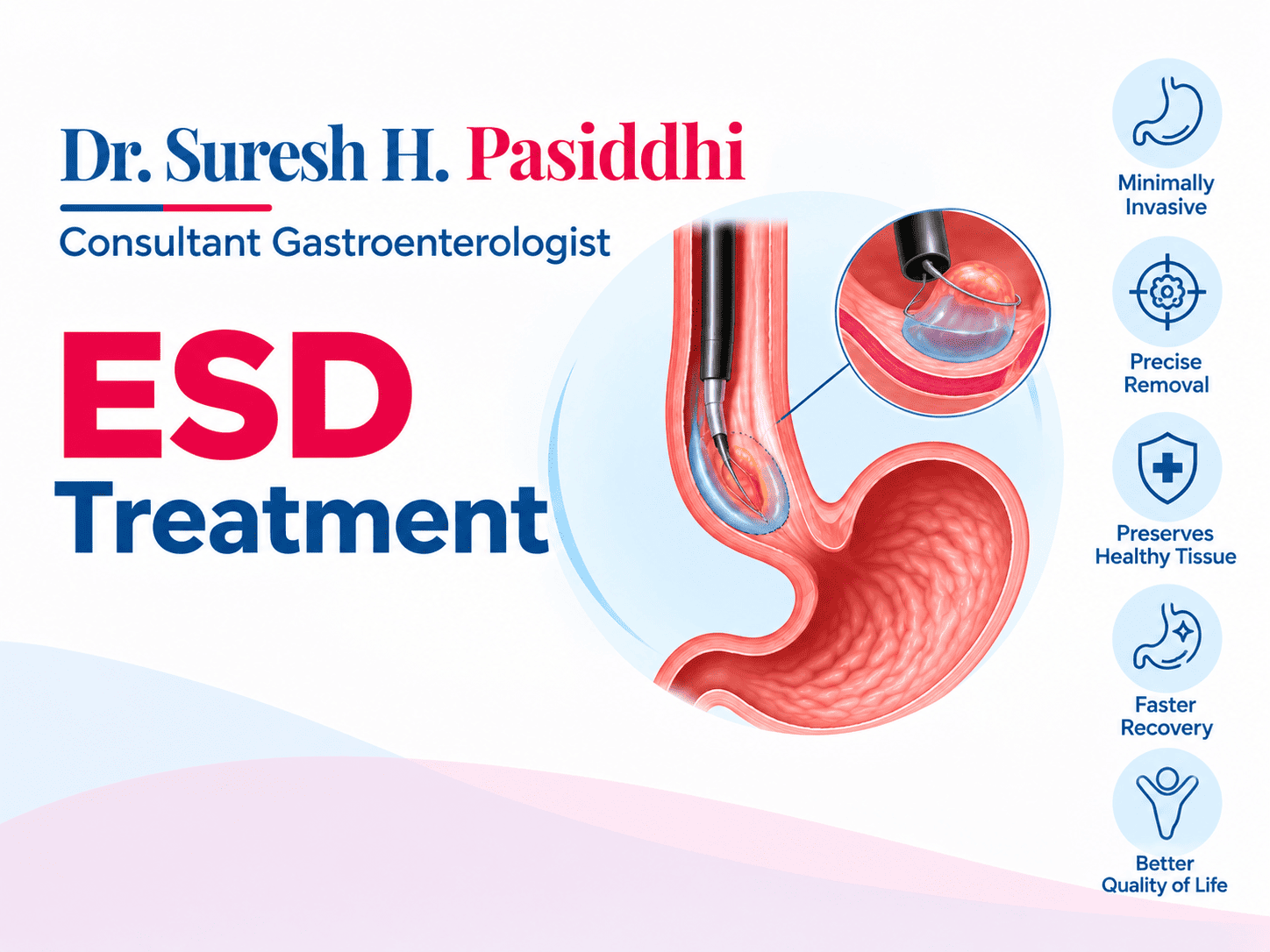
ESD Treatment in Chembur
If you are searching for the ESD Treatment in Chembur, Dr. Suresh H. Pasiddhi is a Consultant Gastroenterologist with advanced training in Medical Gastroenterology and Advanced Endoscopy.
He holds an MBBS from Government Medical College, Miraj, an MD in Internal Medicine from Seth GS & KEMH, Parel, Mumbai, and a DrNB in Medical Gastroenterology from Believer's Church Medical College, Thiruvalla, Kerala. He also completed a Fellowship in Advanced Endoscopy at Antrang Hospital, Kolhapur. With over 10 years of clinical experience across roles such as Junior Resident, Senior Resident, Assistant Professor, SMO and Consultant Gastroenterologist, he is known for careful evaluation and clear, evidence-based guidance. He has presented at MAPCON and ENDO 2024 in South Korea and is a member of the Indian Society of Gastroenterology.
Understanding ESD and Its Types
The doctor uses an endoscope with a flexible tube and tiny instruments to lift the abnormal lesion, cut it from underneath and take it out in one piece so that it can be examined. ESD is done in various parts of the gastrointestinal tract. Esophageal ESD is performed on the cancers and dysplasia of the esophagus, gastric ESD removes cancer and polyps from the stomach and colorectal ESD removes cancers and big flat polyps from the colon and rectum. ESD is different from simple polipectomy or endoscopic mucosal resection (EMR), the methods employed for detection of smaller tumors.
Typical Conditions and Causes
ESD is indicated in cases involving developing cancers, precancerous lesions (such as dysplasia), wide flat polyps and some submucosal tumours which have not penetrated too deep. Chronic acid reflux and Barrett’s esophagus can also lead to transforming the food pipe. Helicobacter pylori and chronic gastritis cause an increase in the chances of developing stomach lesions. Colon polyps are provoked by genetic predisposition, different ages, low-fibre diets, obesity, smoking, drinking along with the history of colon cancer or polyps in the family. Most of the lesions do not show symptoms in their early stages which is exactly why screening and timely endoscopy are of great importance.
Symptoms You Should Not Ignore
Early signs and symptoms are typically asymptomatic and diagnosed through routine screening tests like endoscopy or colonoscopy. Symptoms that manifest themselves include chronic indigestion and upper abdominal pain, difficulty swallowing, fullness after eating small amounts, passing black stools, presence of blood in stools, chronic anemia, changes in bowel movements, and inexplicable weight loss. Having a family history of stomach cancer or colon cancer is another red flag that indicates one should go for consultation.
Treatment Approach
This process starts with a comprehensive history taking, examination, upper gastrointestinal (GI) endoscopy or colonoscopy with biopsy. Endoscopic ultrasound (EUS) may also be used to evaluate the depth of a lesion and whether ESD is the right approach. It is crucial to choose the right ESD Treatment in Chembur as patient selection, techniques and experience highly influence safety and success of this procedure. The ESD procedure is conducted under sedation or anaesthesia and has to be closely monitored. The goal is to get rid of the lesion but retain the organ; this means less trauma, shorter hospital stay and a faster recovery than traditional surgery. The treatment plan is communicated clearly and each decision is made based on the patient’s age, medical condition and health.
Advanced Healthcare Support
Dr. Pasiddhi's advanced training in endoscopy and numerous cases in both upper and lower GI endoscopy, EUS, dilation procedures and advanced treatment interventions creates solid background for dealing with challenging gastrointestinal cases. EUS provides precise evaluation, and therapeutic endoscopy allows to treat lesions using endoscopy without making any incisions. Patients seeking the ESD Treatment in Chembur are usually those who were told that some large polyp or early growth needs surgery, and organ-preserving endoscopic treatment is vital when the lesion is a candidate.
Post-Procedure Care and Long-Term Management
The ESD procedure demands close monitoring of the patient by qualified medical professionals in the hospital for some amount of time based on the diagnosis and size of the procedure area. The patient will observe a gradual diet comprising light liquids or semi-solid food during recovery. Attention should be paid to immediate reporting of any occurrence of severe belly pain, fever, nausea, vomiting blood and black stool afterwards. The removed tissue is assessed carefully for histology and stage of cancer as well as to understand whether there is a need for further procedures or treatments.
Conclusion
It is important to identify and treat digestive problems in their early stages to protect your internal organs from damage and ensure long-term health. Dr. Suresh H. Pasiddhi, a highly experienced healthcare professional with more than ten years of clinical practice and extensive knowledge of state-of-the-art endoscopic technology and methods, offers both effective and patient-oriented healthcare services. If you want the ESD treatment in Chembur and are looking for a proven strategy for the treatment of your condition, you should book an appointment with Dr. Suresh today to get the care you need.
FAQs
What is ESD treatment, and when is it recommended?
ESD stands for Endoscopic Submucosal Dissection. It is an advanced endoscopic procedure used to remove certain early-stage gastrointestinal tumours and abnormal tissue from the digestive tract. It may be recommended when the lesion is suitable for endoscopic removal following specialist evaluation.
Who should I consult for ESD treatment in Chembur?
Patients diagnosed with gastrointestinal polyps, superficial lesions or certain early-stage digestive tract tumours may require evaluation by a gastroenterologist with expertise in advanced endoscopy. Dr. Suresh H. Pasiddhi is a Consultant Gastroenterologist with a DrNB in Medical Gastroenterology and a Fellowship in Advanced Endoscopy. Confirm his availability for ESD procedures before booking.
Which digestive conditions can be treated with ESD?
ESD may be used to remove selected superficial lesions in the oesophagus, stomach, colon and other parts of the gastrointestinal tract. Its suitability depends on the lesion's size, location, depth and suspected nature, as well as the patient's overall health.
What is the difference between ESD and conventional endoscopic polyp removal?
Conventional polypectomy or endoscopic mucosal resection (EMR) may be suitable for many gastrointestinal polyps and superficial lesions. ESD allows selected lesions to be dissected from the deeper supporting tissue layer, often enabling removal in one piece. The appropriate technique depends on the lesion and clinical findings.
Is ESD treatment used for early-stage gastrointestinal cancer?
Yes. ESD can be used to remove selected early-stage gastrointestinal cancers and precancerous lesions when they meet appropriate clinical criteria. The removed tissue is examined by a pathologist to assess factors such as depth of invasion and completeness of removal. Some patients may require additional treatment depending on the results.
What is endoscopic submucosal dissection?
ESD is a type of treatment for cancer in the stomach or esophagus. The procedure is done to remove a tumor that has grown into the second layer of the wall of the stomach or esophagus. This layer is called the submucosa. For some people, ESD may be an option instead of surgery to remove the stomach or part of the esophagus.
Above Short Content Reference Link - https://www.ummhealth.org/health-library/endoscopic-submucosal-dissection-esd
Service Areas
Sion Kurla Govandi Tilak Nagar Chedda Nagar Deonar Kurla East Ghatkopar East Chunabhatti Mankhurd
Google Reviews

“Dr. Pasiddhi explained everything clearly and made me feel comfortable throughout the treatment. Very professional and approachable.”
“I had a very good experience with Dr. Pasiddhi. He listened patiently, explained the problem well, and guided me through the treatment.”
“Highly professional and reassuring doctor. The entire procedure was explained properly, which made the experience much easier.”
“Dr. Pasiddhi is knowledgeable, patient and attentive. I truly appreciated the clear guidance and care throughout my treatment.”