

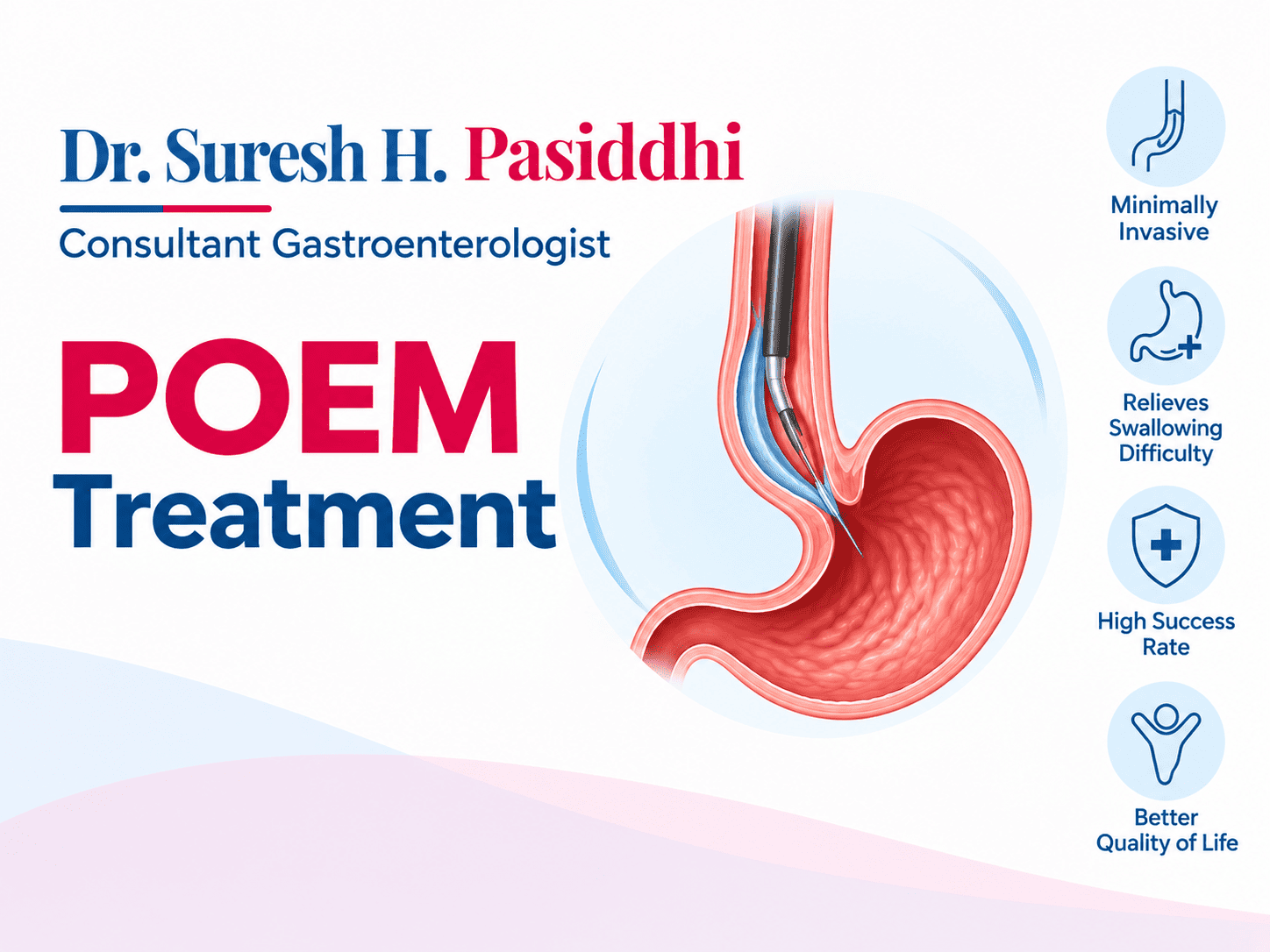
POEM Treatment in Chembur
If you are searching for the POEM Treatment in Chembur, Dr. Suresh H. Pasiddhi is a Consultant Gastroenterologist with advanced training in Medical Gastroenterology and Advanced Endoscopy.
He holds an MBBS from Government Medical College, Miraj, an MD in Internal Medicine from Seth GS & KEMH, Parel, Mumbai, and a DrNB in Medical Gastroenterology from Believer's Church Medical College, Thiruvalla, Kerala. He also completed a Fellowship in Advanced Endoscopy at Antrang Hospital, Kolhapur. With over 10 years of clinical experience across roles such as Junior Resident, Senior Resident, Assistant Professor, SMO and Consultant Gastroenterologist, he is known for careful evaluation and clear, evidence-based guidance. He has presented at MAPCON and ENDO 2024 in South Korea and is a member of the Indian Society of Gastroenterology.
What is POEM and the Disorders upon swallowing
The acronym POEM refers to Peroral Endoscopic Myotomy, a type of minimally invasive endoscopic surgery utilized in treating achalasia cardia. In the condition of achalasia, the muscle at the end part of the food tube (the lower part order of the esophagus) does not manage to relax adequately, and thus, the food and fluids cannot enter the stomach smoothly. The process of POEM is taking place under the effeciency of a doctor working with endoscope through patient’s mouth, which means that there is no any surgical incision present. In the process, there is a perforation of the mucosa, division of the muscle and then closing of the incised area. The associated motility disorders include spastic esophageal disordes such as distal esophageal spasm, jackhammer esophagus, and sometimes gastroparesis.
Common Causes
The most prevalent cause of achalasia is still unclear for most of the patients diagnosed with it. It has been assumed that achalasia occurs due to the steady degeneration of the nerve cells responsible for swallowing and the relaxation of the esophagus. Various suggestions have been made, contributing factors named include autoimmune factors and viral infections in addition to genetic influences. Pseudoachalasia is an example of a condition that simulates the disease due to the presence of a tumor or blockage at the junction of the esophagus and stomach. Consequently, proper testing is crucial.
Signs You Must Pay Attention To
The primary indication is the incapacity to swallow, whether solid or liquid, which becomes progressively worse over months or years. People also experience the regurgitation of food that was not digested, discomfort and pain in the chest area, as well as the feeling that food is remaining in the chest. Moreover, many patients develop frequent cough at night and lose weight even without a cause since regurgitation and chest discomfort may be misdiagnosed as acid reflux. However, chronic problems such as the incapacity to swallow, vomiting of undigested food, recurrent infections of the chest, and weight loss should be evaluated by a specialized physician in time.
Processing Method
The procedure for diagnosis involves taking the complete medical history of the patient, followed by undergoing GI endoscopy for eliminating the possibility of other issues. Following this step, one needs to undergo the barium swallow testing and esophageal manometry for measuring pressure and contractions of the esophagus. Selecting the POEM Treatment in Chembur is the level of effectiveness of any procedure depends highly on making the right diagnosis in combination with patient selection and treatment plan. Basically, the treatment can include the methods of balloon dilation, medications for certain patients, surgical myotomy, and POEM. The choice of treatment has to be correct and needs consideration of the type of achalasia, age of the patient, health status, and preferences, as well as possible risks of the procedure.
Advanced Healthcare Support
Dr. Pasiddhi's expertise in Advanced Endoscopy, coupled with his knowledge of manometry, upper GI endoscopy, dilatation procedures and modern therapeutic methods, gives him a firm base for handling complex swallowing disorders. Precise manometry helps in diagnosing motility problems and making a therapy plan. Moreover, with the help of dilatation, it is possible to eliminate the narrowing of the esophagus. Patients seeking the POEM Treatment in Chembur struggle with chronic symptoms and require a personalized treatment approach. Today’s endoscopic treatment does not involve any complications typical of traditional surgical treatment such as surgery cuts, pain, long hospitalisation and a slow recovery.
Post-Procedure Follow-Up and Long-Term Care
Following an endoscopic myotomy, patients generally remain hospitalized for a short time period. Initially, a clear liquid diet is prescribed and foods that one normally eats can be consumed after some time as recommended by the health professional. Most individuals find great relief in terms of swallowing since the very first days following the treatment. It has to be pointed out that this procedure may contribute to acid reflux and some patients are given medications to prevent it. Eating slowly, chewing well, avoiding meals shortly before going to bed and keeping the head elevated while sleeping may help. It is also important to attend follow-up consultations and inform the medical staff if any severe chest pain, fever, vomiting or difficulties swallowing occur once again.
Conclusion
Experiencing difficulty while swallowing food does not indicate a good sign and prompt diagnosis will help in restoring easy eating back. Dr. Suresh H. Pasiddhi is a trained professional with strong academic base and over a decade of clinical experience along with proficiency in advanced endoscopic techniques. In case you wish to undergo an effective treatment, you should book an appointment for POEM Treatment in Chembur.
FAQs
What is POEM treatment, and who needs it?
POEM stands for Peroral Endoscopic Myotomy. It is a minimally invasive endoscopic procedure primarily used to treat achalasia, a condition that affects the movement of food from the oesophagus into the stomach. A gastroenterologist evaluates the patient's symptoms and test results to determine whether POEM is appropriate.
Who should I consult for POEM treatment in Chembur?
Patients experiencing difficulty swallowing, regurgitation or symptoms associated with oesophageal motility disorders can consult a gastroenterologist for evaluation. Dr. Suresh H. Pasiddhi is a Consultant Gastroenterologist with a DrNB in Medical Gastroenterology and a Fellowship in Advanced Endoscopy. Confirm his current availability for POEM procedures directly with his clinic.
What conditions can be treated with POEM?
POEM is primarily used to treat achalasia. In selected cases, it may also be considered for other oesophageal motility disorders, such as certain types of oesophageal spasm. The suitability of the procedure depends on specialised diagnostic testing and individual clinical assessment.
What are the symptoms of achalasia?
Common symptoms include difficulty swallowing solid foods or liquids, regurgitation of undigested food, chest discomfort, unexplained weight loss and coughing at night. These symptoms can have several causes, so medical evaluation is important for an accurate diagnosis.
How is POEM treatment performed?
During POEM, a flexible endoscope is passed through the mouth into the oesophagus. The doctor creates a small entry in the oesophageal lining and cuts selected muscle fibres to help food pass more easily into the stomach. The procedure is generally performed under general anaesthesia.
Peroral Endoscopic Myotomy (POEM) Procedure
Peroral endoscopic myotomy (POEM) is a minimally invasive treatment for achalasia and other conditions that make it hard for you to swallow food. The procedure loosens muscles in your esophagus so food can move to your stomach. It takes about 10 days to two weeks to recover from a POEM procedure.
Above Short Content Reference Link - https://my.clevelandclinic.org/health/procedures/peroral-endoscopic-myotomy-poem
Service Areas
Sion Kurla Govandi Tilak Nagar Chedda Nagar Deonar Kurla East Ghatkopar East Chunabhatti Mankhurd
Google Reviews

“Dr. Pasiddhi explained everything clearly and made me feel comfortable throughout the treatment. Very professional and approachable.”
“I had a very good experience with Dr. Pasiddhi. He listened patiently, explained the problem well, and guided me through the treatment.”
“Highly professional and reassuring doctor. The entire procedure was explained properly, which made the experience much easier.”
“Dr. Pasiddhi is knowledgeable, patient and attentive. I truly appreciated the clear guidance and care throughout my treatment.”